

Friday, February 27, 2026
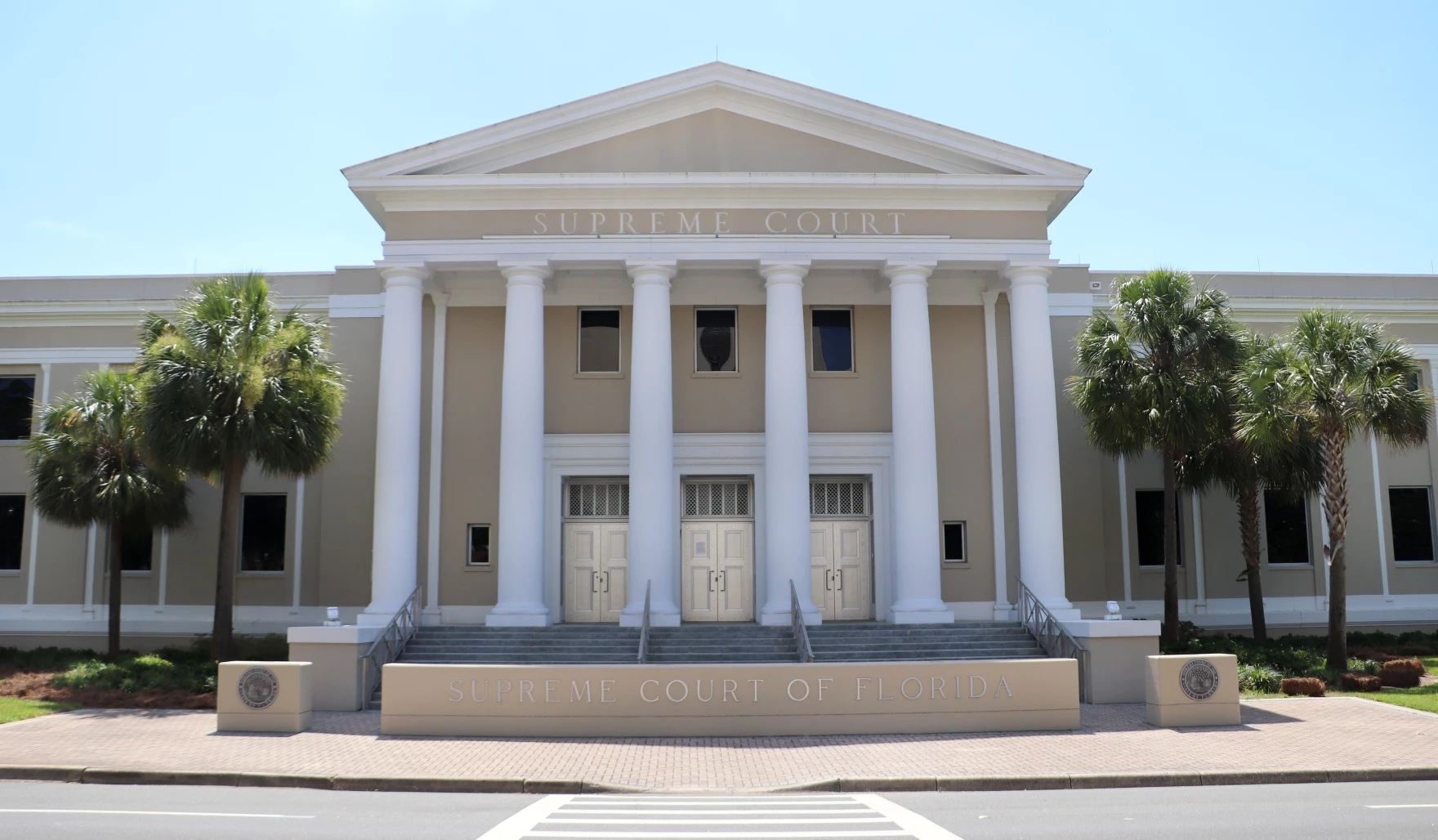
The Supreme Court of Florida on Friday, rejected a petition to block Governor Ron DeSantis’ plan to redraw the state’s congressional districts.
The move dealt a significant early-season victory to Gov. Ron DeSantis’ effort to trigger a mid-decade congressional redistricting, tossing out a lawsuit that sought to halt a special session called for this spring to redraw the state’s U.S. House map.
By blocking that challenge, the court cleared the path for the special session set for April, part of a broader push among Republican-led states to reshape congressional seats well before the next general election in hopes of influencing control of the U.S. House.
Chief Justice Carlos Muñiz issued a brief, two-paragraph ruling stating that the voters’ challenge exceeded the scope of their original petition. The court declined to block the upcoming April special session on redistricting or Secretary of State Cord Byrd’s move to shift the congressional qualifying period from April to June.
Justice Adam Tanenbaum’s Concurrence: Justice Tanenbaum, who was indeed appointed by Governor DeSantis in January 2026 to replace retiring Justice Charles Canady, wrote a separate concurring opinion. He argued that because the court did not reach the actual “merits” (the legal substance) of the voters’ claims, the petition should technically have been dismissed rather than rejected. This is a common procedural distinction in appellate law.
Background
A legal challenge was filed with the Florida Supreme Court alleging that Gov. Ron DeSantis exceeded his constitutional authority by calling a special legislative session to redraw the state’s congressional districts ahead of the 2026 election cycle.
The petition, lodged by two South Florida residents, contends that only the Florida Legislature has the power to determine when and whether congressional redistricting should take place under the state constitution’s separation of powers provisions.
The lawsuit names Gov. DeSantis and Florida Secretary of State Cord Byrd as respondents, challenging both the governor’s proclamation setting an April session and Byrd’s related directive to delay candidate qualifying deadlines.
The petitioners argue that the executive branch cannot unilaterally bind the legislative branch to undertake redistricting, a responsibility they say belongs exclusively to lawmakers. If the court finds DeSantis lacked authority, the plaintiffs are asking that his proclamation and any corresponding actions be declared unenforceable.
Florida’s mid-decade redistricting push comes amid a broader national trend in which several states are considering changes to congressional maps outside the typical post-census cycle. Traditionally, district boundaries are redrawn once every ten years following the decennial census, but recent efforts — including this one — have sparked significant controversy and litigation over the appropriate roles of different branches of government in the process.
Florida Gov. Ron DeSantis announced that he will convene a special session of the Florida Legislature this April to redraw the state’s congressional district maps, placing the Sunshine State at the center of ongoing national debates over redistricting ahead of the 2026 midterm elections.
The special session, outlined in a formal proclamation from DeSantis, is scheduled to run from April 20 through April 24 and will be devoted exclusively to legislation related to congressional redistricting and any associated funding for legal challenges.
“At least one or two districts in Florida could be affected” by an imminent U.S. Supreme Court ruling on the Voting Rights Act,” DeSantis said at a news conference, referring to the pending Louisiana v. Callais case that could alter how Section 2 of the act is applied. “We’re getting out ahead of that.”
Redistricting amid legal uncertainty
DeSantis said his decision to delay redistricting until April — after the regular 2026 legislative session — was intended to give lawmakers time to focus on other priorities before engaging fully with what he characterized as a complex legal backdrop for congressional maps.
The governor pointed to recent legal developments and shifting demographics, saying that the 2022 map could be vulnerable to legal challenge or invalidation depending on the Supreme Court’s interpretation of federal voting rights law.
Florida’s current congressional map, enacted after the 2020 Census, gives Republicans a significant advantage, with 20 of the state’s 28 U.S. House seats held by GOP members and just eight by Democrats.
DeSantis and supporters argue that updating districts is necessary to ensure they accurately reflect Florida’s population distribution. Critics, including state Democrats and voting rights advocates, contend that the move is a partisan effort to reinforce the Republican Party’s hold on House seats and could conflict with Florida’s constitutional ban on partisan gerrymandering.
Legislative and legal landscape
Secretary of State Cord Byrd has also declared 2026 a “year of apportionment,” adjusting candidate qualification timelines to accommodate the redistricting process.
Some Republican lawmakers have expressed support for the governor’s timeline, though there is internal tension over whether redistricting should be handled in the regular session rather than a later special session. House Redistricting Committee Chair Rep. Mike Redondo previously argued that delaying could jeopardize the election calendar.
Meanwhile, Florida’s Democratic leaders have sharply criticized the announcement. House Democratic Leader Fentrice Driskell said the plan conflicts with the state’s constitutional protections against partisan gerrymandering and described it as an attempt to entrench political advantage.
Part of a broader national trend
Florida’s planned mid-decade redistricting mirrors efforts in other states — both Republican- and Democratic-led — seeking to adjust congressional boundaries ahead of the midterm elections. Nationally, redistricting battles have already taken shape in multiple states, driven in part by differing interpretations of federal law and strategic considerations ahead of the 2026 election cycle.
With the special session now scheduled, Florida lawmakers are preparing for a high-stakes showdown over the state’s political map — a process that could have significant implications for both state and national electoral outcomes later this year.
Source: AP News / CBS News / Florida Governor’s Office / Tampa Bay Times / WGCU PBS / WUSF