

March 15, 2026 Story by: Publisher
The funeral services for Rev. Jesse Jackson Sr. were a powerful testament to his global impact, bringing together an extraordinary assembly of former presidents, civil rights icons, and world leaders. Former Presidents Barack Obama, Bill Clinton, and Joe Biden each delivered moving tributes, with Obama crediting Jackson’s historic presidential runs for breaking the barriers that made his own presidency possible. The services featured stirring addresses from Vice President Kamala Harris, Rev. Al Sharpton, and California Congresswoman Maxine Waters, complemented by deeply personal eulogies from his children, including Jesse Jackson Jr. and Jonathan Jackson.
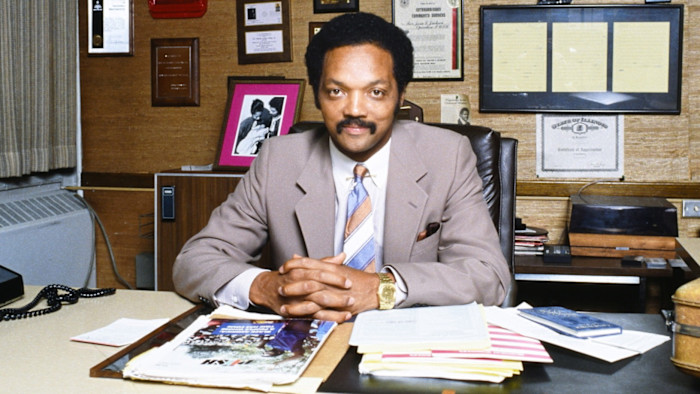
The Reverend Jesse Louis Jackson Sr., the fiery orator and master strategist who marched with Dr. Martin Luther King Jr. and later transformed American politics with two historic presidential runs, died peacefully Tuesday, February 17 morning. He was 84.
His family confirmed his passing in a statement, describing him as a “servant leader” who dedicated seven decades to the “oppressed, the voiceless, and the overlooked.” Jackson had been battling progressive supranuclear palsy, a rare neurological disorder, following a long-publicized fight with Parkinson’s disease.
From the Front Lines to the Ballot Box
Born in the segregated South in Greenville, South Carolina, Jackson went on to graduate from North Carolina A&T State University, a historically Black university, in 1964. Jackson rose to prominence as a young, charismatic protégé of Dr. King. He was a key organizer for the Southern Christian Leadership Conference (SCLC) and was present at the Lorraine Motel in Memphis on the day of King’s assassination in 1968.
While many wondered who would carry the mantle of the movement, Jackson moved to Chicago and founded Operation PUSH (later the Rainbow PUSH Coalition). He pioneered the use of economic boycotts to force major corporations to hire Black workers and invest in minority-owned businesses, famously declaring to the masses: “I am Somebody.”
Though this moment created a rift with some of King’s older aides—who viewed it as a calculated grab for the spotlight—it undeniably propelled Jackson into a national leadership role. He returned to Chicago to launch Operation Breadbasket and later Operation PUSH, using “economic withdrawal” (boycotts) to force corporations like Coca-Cola and Burger King to open their doors to Black employees and contractors.
By 1971, Jackson had launched PUSH — originally known as People United to Save Humanity — as a mission to improve economic opportunities for Black communities, even as the broader civil rights movement struggled to regain its footing after King’s murder, with Richard Nixon in the White House.
The Rainbow Coalition and Presidential History
In the 1984 contest, Jackson was up against Walter Mondale, the former vice-president from Minnesota, and Gary Hart, a senator from Colorado. Jackson did not come close to winning the nomination — which went to Mondale — but he did win more than 3mn votes in the primary process, nearly 20 per cent of ballots cast.
Jackson’s most enduring political legacy remains his 1984 and 1988 presidential campaigns. At a time when a Black president seemed a distant impossibility, Jackson built the “Rainbow Coalition”—a multiracial, working-class alliance of Black, Latino, white, and marginalized Americans.
His 1988 campaign, in particular, shook the Democratic establishment. He won 13 primaries and caucuses and delivered one of the most famous convention speeches in history, chanting the refrain that would define his career: “Keep hope alive!” His runs expanded the voter rolls by millions and paved the way for the eventual presidency of Barack Obama.
Voter Mobilization: He registered millions of new voters, particularly in the South, proving that a multiracial coalition of the “disenfranchised” could win major states like Michigan and South Carolina.
Four years later, in 1988, Jackson came even closer to the White House. He won more than 29 per cent of the primary vote, and almost 7 million supporters, before being edged out by Michael Dukakis for the Democratic nomination.
The Jackson Legacy: A New Generation of Leaders
Leah Daughtry: Recruited by Jackson as a college student to mobilize young voters, she went on to become a high-ranking political strategist and CEO of the Democratic National Convention.
Donna Brazile: After starting her political career on Jackson’s 1984 campaign, she made history in 2000 as the first Black woman to manage a major-party presidential campaign.
Minyon Moore: Tapped as a deputy field director for Jackson’s 1988 run, she rose to become the first Black woman to serve as White House Director of Political Affairs under Bill Clinton.
Maxine Waters: The long-serving California Congresswoman co-chaired Jackson’s 1984 and 1988 presidential bids, using the experience to help cement her own legislative legacy.
Melanie Campbell: Inspired by her time as a student volunteer for Jackson, she now leads the National Coalition on Black Civic Participation as a prominent civil rights leader.
Shirley Chisholm: Mentioned as a predecessor, she was the first Black woman to run for president in 1972, paving the way for the “Rainbow Coalition” that Jackson later expanded.
The Blueprint for Obama
By winning 7 million votes in 1988, he proved that a Black candidate could be a serious contender for the White House. Jackson famously stood in Grant Park in 2008, tears streaming down his face, as he watched Barack Obama become President.
A Global Diplomat
Beyond domestic politics, Jackson became a “shadow diplomat.” He successfully negotiated the release of American prisoners in Syria, Cuba, and Iraq, often stepping into international crises where official U.S. channels had failed.
Jackson’s influence famously extended beyond U.S. borders. He acted as a freelance diplomat in some of the world’s most dangerous flashpoints:
- 1984: He traveled to Damascus to negotiate the release of Navy Lt. Robert Goodman, whose plane had been shot down over Lebanon.
- 1999: He secured the release of three American soldiers captured during the Kosovo conflict.
- Aparthied: He was a vocal global leader against the apartheid regime in South Africa, maintaining a close bond with Nelson Mandela.
A Life of “Building Bridges”
In his final years, despite declining health, Jackson remained a fixture at protests and voting rights rallies. He often remarked that his mission was to “tear down walls and build bridges.”
He is survived by his wife of over 60 years, Jacqueline, and their five children. While the cadences of his powerful voice have now quieted, the “Rainbow” he built remains a foundational part of the American political fabric.
Current Memorial & Funeral Schedule
As of late February 2026, a series of “cross-country” memorial services are taking place to honor his global legacy:
- Chicago (Feb 26–27): Public visitations were held at the Rainbow PUSH Coalition headquarters, where thousands of mourners, including Mayor Brandon Johnson and Rev. Al Sharpton, paid their respects.
- South Carolina (March 2): At the request of his family and state lawmakers, Rev. Jackson will lie in state at the South Carolina Statehouse in Columbia. Governor Henry McMaster has ordered flags to be flown at half-staff.
- Final Service (March 7): A “homegoing” service is scheduled at the Rainbow PUSH Coalition Community House in Chicago.
Source: AP News / Financial Times / The 19th