

Saturday, January 24, 2026
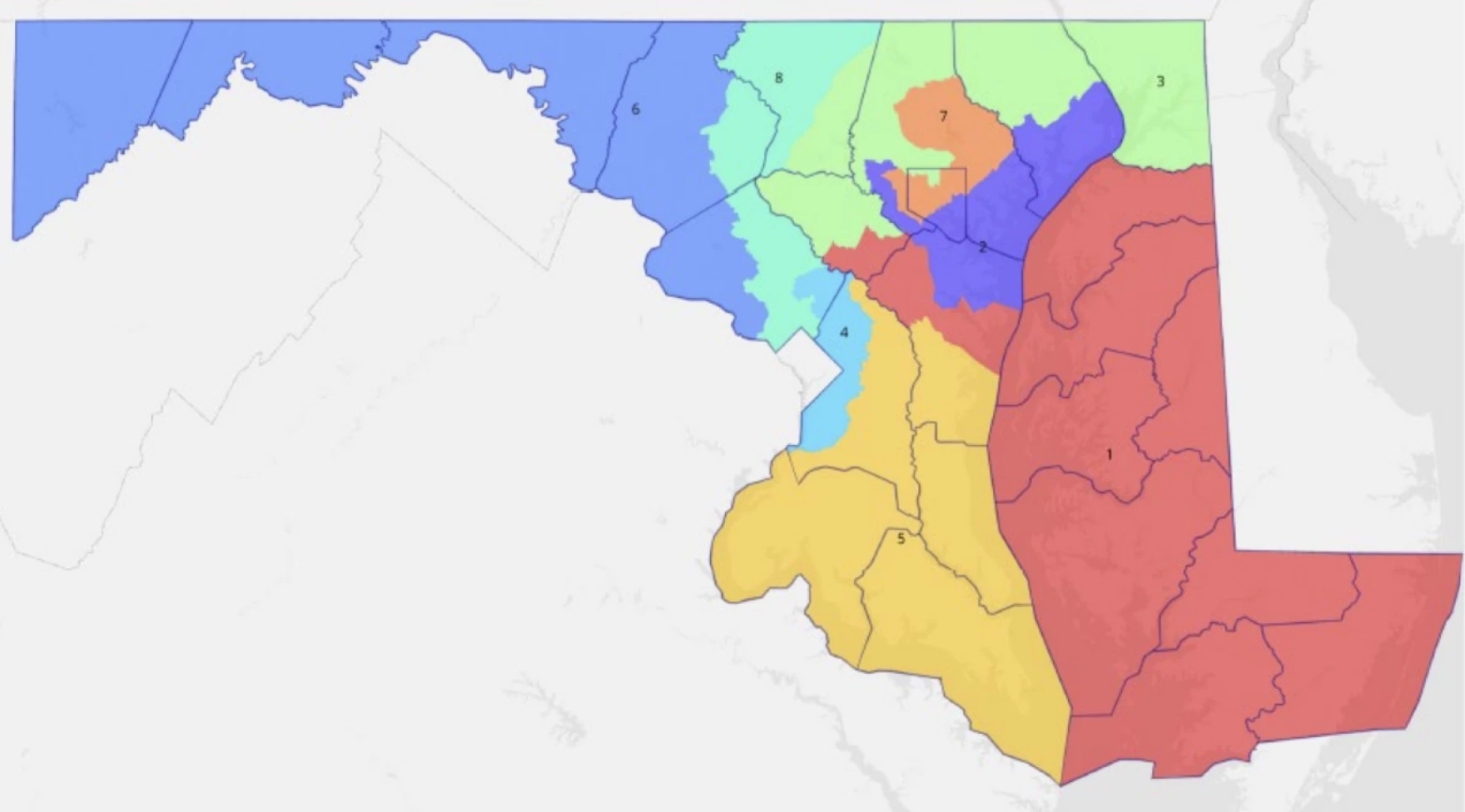
Maryland’s Governor’s Redistricting Advisory Commission voted to approve a new proposed congressional map that could reshape the state’s political landscape and potentially give Democrats control of all eight of Maryland’s U.S. House seats. The decision reached in a close 3–2 vote advances the map to the Maryland General Assembly, where lawmakers will amend, debate, and vote on it in the coming weeks.
The commission’s action represents a significant shift in Maryland’s congressional boundaries ahead of the 2026 elections and follows weeks of public hearings and behind-closed-doors negotiations among political leaders and stakeholders.
What the proposed map changes
Under the newly recommended map concept:
Maryland’s currently Republican-held 1st Congressional District — the Eastern Shore seat represented by U.S. Rep. Andy Harris — would be substantially redrawn to include more Democratic-leaning territory from Anne Arundel and Howard counties, removing some of the more reliably Republican areas in Cecil and Harford counties.
If enacted, the map is widely expected to create a delegation of eight Democratic representatives, eliminating Maryland’s sole Republican seat in Congress.
The Legislative Path Forward
With the commission’s recommendation complete, the map now advances to the Maryland General Assembly. Leadership in both the House and Senate have signaled that they will take up the issue swiftly, moving to convert the commission’s concept into legislative language and schedule votes in both chambers.
Democratic lawmakers allied with Governor Wes Moore have emphasized their intent to refine and pass the map in time for the state’s primary election cycle. However, opponents within the Democratic caucus and across the aisle have vowed to use procedural tools and, if necessary, litigation to block the plan.
What happens next?
Legislators in Annapolis are expected to begin committee hearings on the map concept immediately, with floor votes scheduled as part of the current legislative session. If the General Assembly passes the bill, opponents have indicated they may challenge it in state or federal court on constitutional grounds. Legal challenges could hinge on one-person, one-vote requirements or other provisions governing how and when maps can be altered.
Background
Maryland Governor Wes Moore announced the reconstruction of the Governor’s Redistricting Advisory Commission in November. The commission was designed to examine and propose revised maps of Maryland’s congressional districts.
The move comes amid mounting national pressure over map-making and follows the step by Bill Ferguson, President of the Maryland State Senate, who recently declared the Senate will not initiate a mid-cycle redistricting effort.
The commission will be chaired by Angela Alsobrooks (U.S. Senator from Maryland), a close ally of the governor.
Other initial appointments include former Maryland Attorney General Brian Frosh and Ray Morriss, Mayor of Cumberland. The commission will also include designees from the House Speaker and possibly the Senate President. The governor’s statement says the commission will hold public hearings across the state, gather community input, and develop draft maps to be submitted to the General Assembly.
Despite the governor’s push, Maryland’s redistricting plan faces internal tension. Senate President Ferguson sent a letter last week indicating the Senate would not support mid-cycle redistricting. He cited concerns that rushing to redraw maps could backfire—potentially costing seats in court. He also raised concerns about racial equity: in a state with top elected officials who are Black, Ferguson questioned the optics of embarking on so-called “mid-cycle” redrawing.
The reconstruction of the commission purpose is to organize public hearings and make legislative and congressional redistricting recommendations to the governor and Maryland General Assembly.
“As states around the country have begun the process to redistrict Congressional seats mid-cycle, Governor Moore has asked the commission to engage Marylanders, receive public comment, and provide recommendations to ensure our Congressional maps are representative and fair.”
Commission members:
Chair: Senator Angela Alsobrooks
Cumberland Mayor Raymond Morriss
Senate President Bill Ferguson or designee
Speaker Adrienne A. Jones or designee
Former Attorney General Brian Frosh