

March 12, 2026 Story by: Publisher
A Jackson County judge on Thursday, issued a pivotal ruling on the constitutionality of the congressional map, just days after the Missouri Supreme Court began hearing oral arguments regarding the controversial shift. The lower court judge ruled that Missouri’s congressional district maps, which were redrawn in 2025, are constitutional.
Plaintiffs in this case asked the court to declare the 2022 congressional maps as the legally operative map for the 2026 elections in Missouri.
The judge upheld the redrawn maps, ruling they did not violate the Missouri constitution.
“Plaintiffs failed to meet the heavy burden required under Missouri law,” the judge wrote in the decision. “Plaintiffs failed to prove clearly and undoubtedly that the 2025 Plan was not as compact as may be.”
The decision means the map Missouri lawmakers drew in 2025, which redrew the boundaries of the state’s eight congressional districts, will remain in effect unless overturned on appeal.
Governor Mike Kehoe signed House Bill 1 into law in late September, enacting a new congressional map poised to grant Republicans a 7‑to‑1 edge in the state’s U.S. House delegation. Alongside the redistricting changes, the legislation drastically alters the state’s ballot initiative process, making it much harder for voters to pass citizen-led amendments.
The newly passed map fractures parts of Kansas City’s 5th District by splitting Black communities across multiple districts and merging them with Republican‑leaning areas. The map will eliminate one of Missouri’s few reliably Democratic districts, weakening representation for Black voters.
The Missouri Senate voted 21-11 on earlier this month to pass legislation that will redraw the state’s congressional districts.
The redistricting plan will break up the Fifth Congressional District currently represented by Democratic U.S. Rep. Emanuel Cleaver.
Kansas City will be split among three separate districts.
The Supreme Court Hearing: A “Mid-Decade” Dispute
The lower court’s decision has accelerated the timeline for the Missouri Supreme Court, which held oral arguments on March 10. The core of the legal dispute rests on whether the Republican-led legislature had the authority to redraw maps mid-decade, rather than waiting for the 2030 census.
Attorneys representing the state argued that the legislature maintains the sovereign right to correct “population imbalances” at any time. However, plaintiffs—including civil rights organizations and voters from the 5th District—argued that the move was a “purely partisan power grab” designed to secure a 7-to-1 Republican advantage in Missouri’s eight-seat U.S. House delegation.
Missouri’s revised map targets a seat held by U.S. Rep. Emanuel Cleaver (D‑Kansas City) by shaving off portions of his Kansas City district and stretching the rest of it into Republican-heavy rural areas. The plan reduces the number of Black and minority residents in Cleaver’s district, partly by creating a dividing line along a street that Cleaver said had been a historical segregation line between Black and white residents.
Cleaver, who was Kansas City’s first Black mayor, has served in Congress for over 20 years. He won reelection with over 60% of the vote in both 2024 and 2022 under districts adopted by the Republican-led state Legislature after the 2020 census.
Arguing for the plaintiffs, attorney Chuck Hatfield said he was asking the court to uphold the plain language of the Missouri Constitution when it comes to redistricting.
“It’s important to read the whole of section 45. It starts with the census of 1950, when the census of 1950 is certified to the governor, but then it says, ‘And at each census thereafter, the General Assembly shall conduct its redistricting.’ It is undisputed,” Hatfield said.
Hatfield argued that means allowing redistricting only once a decade.
“The whole idea is tethered to the census data. You must do it at the census, and you only do it at the census,” Hatfield said.
Representing the state, Solicitor General Lou Capozzi said the Missouri Constitution is silent on the topic of mid-decade redistricting.
“This court has long held that the General Assembly has the power to act unless the Missouri Constitution expressly takes a particular power away,” Capozzi said.
Capozzi agreed with Hatfield that the legislature does have a duty to redistrict after a census.
“But that’s all the language does. That’s all it says. It simply says nothing about whether mid-decade redistricting is possible,” Capozzi said.
Missouri Senate panel advances map; U.S. Rep Emanuel Cleaver’s testimony
A Missouri Senate subcommittee moved forward a redistricting plan that will reshape the state’s Black Democratic districts.
U.S. Rep. Emanuel Cleaver (D-Kansas City), whose Fifth Congressional District would be dramatically altered under the proposal, traveled to Jefferson City last year to testify before the Senate Local Government, Elections and Pensions Committee. Cleaver warned lawmakers that the map is a partisan effort to weaken Black voting strength and shift power toward Republican candidates.
Despite Cleaver’s objections, the committee approved the redistricting plan in a 6‑2 party‑line vote. It had already passed in the Missouri House and will now go to the full Senate for debate.
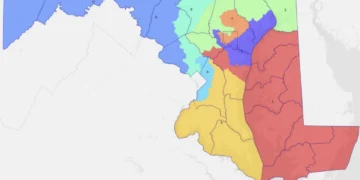
Under the new map, parts of Cleaver’s 5th District in Kansas City and Jackson County would be split and merged into the 4th and 6th Districts. At the same time, heavily Republican areas along the Missouri River would be added to remaining portions of Kansas City.
Cleaver said polling in his district indicates strong opposition to the redistricting map. “This is immensely unpopular,” he told legislators, adding that he intends to run again regardless of the outcome.
Missouri House of Representatives
The Missouri House of Representatives passed a new congressional map—dubbed the Missouri First Map—that redraws the state’s political terrain. The Missouri House gave final approval to both proposals Tuesday after two days of contentious debate.
The Missouri House approved the Republican-backed congressional map in a 90–65 vote, splitting the Democratic-leaning 5th District, currently held by Rep. Emanuel Cleaver (D), into three different districts. The redraw is expected to bolster Republicans, potentially turning seven of Missouri’s eight seats in the U.S. House GOP-controlled.
The House voted 89-63 Monday night to adopt Rep. Dirk Deaton’s legislation, which would link a portion of Cleaver’s Kansas City-based district to a number of largely rural counties. It would also place other parts of the state’s largest city into the districts of Reps. Mark Alford and Sam Graves, put all of St. Charles County into Rep. Bob Onder’s 3rd District and add part of Jefferson County and all of Washington, Gasconade and Crawford counties to Rep. Ann Wagner’s 2nd District.
The two bills now move to the Republican-led Senate, where procedural resistance—like filibusters—is expected from Democrats.
If passed, Republicans may invoke seldom-used rules to force a vote, deepening partisan tensions.
The Missouri Constitution allows for a referendum. If opponents of the new congressional lines can get a little over 100,000 signatures in six out of eight congressional districts within 90 days, Deaton’s bill can’t go into effect until after there’s a statewide vote on the proposal.
Bills that have what’s known as an emergency clause that go into effect upon the governor’s signature can’t be placed up for a referendum. But emergency clauses require 109 votes in the House, and Deaton’s bill received 89 votes. And because Republicans only have 107 members and no Democrats are expected to vote for the new map on final passage, the referendum route is one possible pathway to keep Cleaver’s district safe going into the 2026 election cycle.
Targeting the 5th District
The new map fractures the urban core of Kansas City—once unified under one district with a large portion of the city’s Black community placed in Rep. Mark Alford’s 4th District. The new map divides it across rural and suburban territories. This move significantly weakens the influence of the Black community.
It would also place the western part of Kansas City in Rep. Mark Alford’s 4th District and all of Clay County in Rep. Sam Graves’ 6th District.
In the St. Louis region, St. Charles County would be completely in Rep. Bob Onder’s 3rd District, while Rep. Ann Wagner’s 2nd District would take in parts of Jefferson County and all of Gasconade, Crawford and Washington counties.
NAACP lawsuit
The NAACP filed a lawsuit in Cole County Circuit Court seeking to block Missouri Governor Mike Kehoe’s special legislative session, arguing that it is unconstitutional and poses a threat to the voting rights of Black residents.
Filed on September 3, 2025, the lawsuit asserts that Kehoe’s convening of the special session is not justified under the Missouri Constitution. It further contends that the proposed redistricting plan would fragment Black political influence, particularly within the Kansas City area, effectively diluting the community’s electoral power.
“Our communities already face systemic barriers to full participation in our democracy,” said Nimrod T. Chapel Jr., President of the Missouri State Conference of the NAACP. “This attempt to redraw maps behind closed doors and outside of regular order is nothing more than an attack on Black Missourians’ ability to elect leaders who reflect and respect their needs. We will use every tool at our disposal to stop it.”
The NAACP, in partnership with the Missouri State Conference of the NAACP, is challenging the state’s effort to convene a special legislative session aimed at redrawing political maps in a manner that would weaken the voting power of Black Missourians.
The lawsuit marks the first legal challenge against the special session convened by Gov. Mike Kehoe to redraw the state’s congressional map and splinter Kansas City to create a 7-1 Republican-dominated map.
The map proposed by Kehoe and Missouri Republicans would carve up Kansas City and splinter votes from the 5th Congressional district into the 4th and 6th districts, lumping together urban voters into more rural districts currently held by Republicans.
Plaintiffs in the Lawsuit
The lawsuit names Governor Kehoe and other state officials as defendants and seeks an injunction to prevent the special session from proceeding. The NAACP is joined in the lawsuit by two individual plaintiffs: Patricia Jones, a Kansas City resident, and Traci Wilson Kleekamp, a Columbia resident. The plaintiffs argue that the redistricting plan would directly harm their ability to participate in the political process and dilute their votes.
Source: Associated Press / Democracy Docket / KCUR / NAACP / Missouri Independent