

May 18, 2026 Story by: Publisher
The Supreme Court of the United States on Monday, May 18 vacated a lower court order requiring Mississippi to redraw portions of its state legislative maps in a closely watched Voting Rights Act case involving Black voting representation.
In a brief order, the nation’s highest court sent the case back to the lower court for reconsideration in light of the Supreme Court recent ruling in Louisiana v. Callais, a decision that reshaped how courts evaluate the use of race in redistricting disputes.
Justice Jackson, dissenting, wrote that the case “presents only the question of Section 2’s private enforceability,” which she said the Supreme Court did not address in Louisiana v. Callais. As a result, Jackson said she saw “no basis for vacating the lower court’s judgment.”
A three-judge panel required redistricting and special elections last year in the Mississippi Legislature for alleged violations of Section 2 of the Voting Rights Act.
Mississippi officials appealed the ruling to the Supreme Court, arguing that the lower court improperly relied on race in its analysis of the districts. The state also pointed to the Supreme Court’s recent Callais decision, which tightened constitutional limits on race-based redistricting.
Only four Black justices had ever sat on the court at the time of the lawsuit despite the state’s nearly 40% Black population, they argued, and never more than one at a time. The plaintiffs proved in court, using the 1965 Voting Rights Act, that the lines did not accurately represent the state’s demographics.
Fifth Circuit Court of Appeals vacates liability order
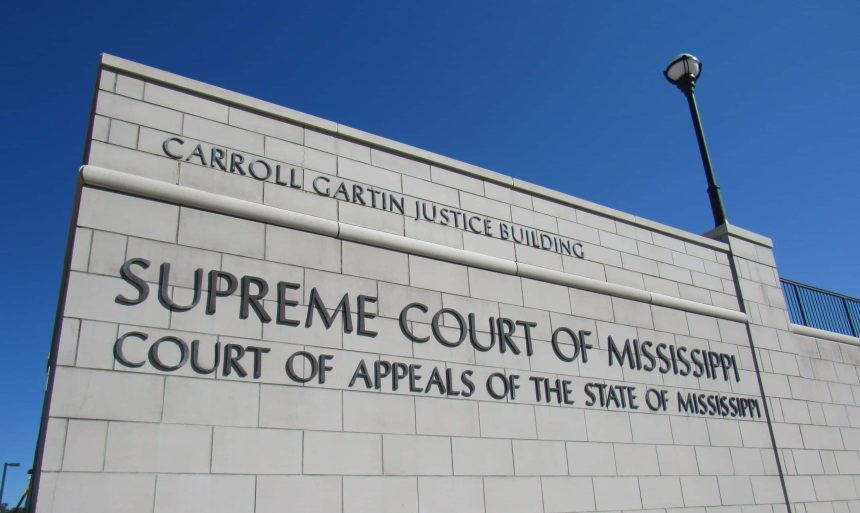
The U.S. Fifth Circuit Court of Appeals vacated the liability order of the three-judge panel that would have required Mississippi lawmakers to redraw the state’s Supreme Court voting districts.
Governor Tate Reeves shared the Fifth Circuit’s action on Monday, May 11 saying, “Post Callais, both the plaintiffs and the State jointly requested this action.”
The move follows a joint request from both the plaintiffs and the state after the U.S. Supreme Court ruled in Louisiana v. Callais that race cannot be the predominant factor in drawing voting districts.
The 5th U.S. Circuit Court of Appeals granted a motion to cancel U.S. District Judge Sharion Aycock’s 2025 ruling in Dyamone White et al. v. the State Board of Election Commissioners. That original order had required the state to redraw its 1987 map to create a majority-Black district and comply with the Voting Rights Act of 1965.
With the previous order vacated, Mississippi leaders now have the option to maintain the existing judicial districts. The Fifth Circuit’s decision effectively ends the immediate requirement for a special legislative session to redraw the Supreme Court map, as the legal basis for the mandate no longer stands under the current Supreme Court precedent.
Mississippi Governor calls special legislative session to redraw the state’s judicial districts
Mississippi Gov. Tate Reeves on Friday, April 24 announced plans to convene a special legislative session to redraw the state’s judicial districts.
The Governor’s move comes at a moment of heightened legal and political urgency, as the state faces mounting pressure to align its judicial maps with modern population shifts and recent federal court precedents.
“During the recently completed regular session,” Reeves wrote in a post on X. “The Legislature discussed drawing new maps to comply with a decision from a federal judge from the Northern District of Mississippi – a decision that has been appealed to the 5th Circuit and the appeal has been heretofore stayed pending future U.S. Supreme Court decisions. It is my belief and federal law requires that the Mississippi Legislature be given the first opportunity to draw these maps. And the fact is, they haven’t had a fair opportunity to do that because of the pending Callais decision. For those reasons, I am using my constitutional authority to allow the Mississippi Legislature to use their constitutionally recognized right to draw these maps once the new rules of the game are known following Callais.”
This marks the first time in over 30 years that Mississippi has undertaken a comprehensive, state-wide redistricting of its trial courts. Mississippi lawmakers have not redrawn state Supreme Court districts since 1987.
“It is my sincere hope that,” Reeves continued, “in deciding Callais, the U.S. Supreme Court will reaffirm the animating principle that all Americans are created equal, and that when the government classifies its citizens on the basis of race even as a perceived remedy to right a wrong, it engages in the offensive and demeaning assumption that Americans of a particular race, because of their race, think alike and share the same interests and preferences.”
At the heart of the special session is a federal court ruling that found Mississippi’s current judicial districts specifically those for the state Supreme Court violate protections for Black voters. Louisiana v Callais challenges the scope of Section 2, a key provision of the Voting Rights Act that prohibits voting practices that discriminate based on race.
A federal judge previously determined that the existing map diluted Black voting strength, requiring the state to redraw its districts.
Rather than immediately complying, Reeves has opted to wait for guidance from the Supreme Court’s forthcoming decision in Louisiana v Callais.
Unlike congressional or legislative redistricting, the upcoming session will focus on judicial districts, which determine how judges particularly state Supreme Court justices are elected. These districts carry significant influence over legal outcomes, including cases involving elections, civil rights, and state policy.
While Reeves has confirmed the special session will occur after the Supreme Court ruling, no exact date has been set.
Mississippi legislative update: SHIELD Act moves forward as lawmakers punt on Supreme Court redistricting
Mississippi’s struggle over equal representation reached a stalemate this week as on Tuesday March 31, legislative leaders confirmed that they would not advance a plan to redraw the three sprawling districts used to elect the nine justices of the Mississippi Supreme Court. These boundaries have remained largely unchanged since 1987, despite dramatic shifts in the state’s population and demographics.
The punt follows a landmark ruling by U.S. District Judge Sharion Aycock, who found that the current judicial maps violate the Voting Rights Act by diluting the strength of Black voters. Specifically, the Central District, which includes the heavily Black Mississippi Delta has been drawn in a way that prevents Black residents from having a fair opportunity to elect more than one justice to the bench.
By failing to act during the regular session, lawmakers have effectively handed the map-making pen back to the federal courts.
The state defendants asked the 5th U.S. Circuit Court of Appeals to overturn her decision. The state did not ask Aycock to pause lower-court proceedings while the appeal played out. The 5th Circuit, however, did pause its appellate proceedings until the U.S. Supreme Court hands down its decision in a Louisiana case that many expect will gut much of the federal Voting Rights Act, and allow states more free rein in redistricting.
The main district at issue in the case is the Central District, which comprises many parts of the majority-Black Delta and the majority-Black Jackson Metro area. Currently, two white justices, Kenny Griffis and Jenifer Branning, and one Black justice, Leslie King, represent the district.
No Black person has ever been elected to the Mississippi Supreme Court, in the state with the highest percentage of Black residents, without first obtaining an interim appointment from the governor, and no Black person from either of the two other districts has ever served on the state’s high court.
U.S. District Judge Sharion Aycock issued the decision on Tuesday August 19, 2025 ordering the state to redraw its election map.
The existing map divides the state into three districts for nonpartisan, staggered elections of nine justices. Despite Black residents comprising approximately 40% of Mississippi’s population, only four Black justices have ever served on the court, all appointed to the same seat in District 1, which includes Jackson and parts of the Mississippi Delta. None of these justices were elected.
Aycock, in a December order, wrote that if the Legislature ends its session without adopting a new map, attorneys are required to provide a formal notice to her within seven days after the end of the session. After receiving notice, she will meet with attorneys to discuss the next steps in the litigation.
Mississippi Senate Rules Committee
The Mississippi Senate Rules Committee on Monday, March 30, formally rejected a bid to undo a redistricting plan that creates new opportunities for Black voters to elect candidates of their choice. The decision keeps the state on track to comply with a federal court order that found Mississippi’s current maps illegally diluted Black voting power.
A last-minute measure would have turned two majority-Black state Senate districts back into majority-white districts if the U.S. Supreme Court weakens the federal Voting Rights Act. No member of the states’ Senate Rules Committee voted to advance the measure out of committee.
Joint Resolution 201, filed by Sen. Jeremy England (R-Vancleave), would have amended the 2025 remedial redistricting plan to include a trigger provision: If the U.S. Supreme Court rules in Louisiana v Callais that Louisiana’s congressional map violates the Constitution or is nonjusticiable, Mississippi’s current Senate districts would automatically revert to Joint Resolution 202. The 2022 maps did not include the majority-Black districts now held by state senators Johnny DuPree and Teresa Isom.
Background
The controversy stems from a 2024 federal court ruling where a panel of federal judges determined that Mississippi’s 2022 redistricting maps violated Section 2 of the Voting Rights Act by “cleaving” Black communities in areas where the population was high enough to warrant majority-minority districts.
The Mississippi State Conference of the NAACP filed a lawsuit in 2022 against the Mississippi Board of Election Commissioners, Gov. Tate Reeves, Attorney General Lynn Fitch and Mississippi Secretary of State Michael Watson, claiming that the legislative voting maps “illegally dilute the voting strength of Black Mississippians.”
The U.S. District Court for the Southern District of Mississippi’s Northern Division agreed with the NAACP in a 2024 decision and ordered the Legislature to redraw its districting maps to create more Black-majority districts to give Black voters equal participation in the political process.
The panel, comprised of U.S. District Judge Daniel Jordan, U.S. District Judge Sul Ozerden and U.S. 5th Circuit Court of Appeals Judge Leslie Southwick, previously ruled that when lawmakers redrew their districts in 2022 to account for population shifts, they violated federal civil rights law because the maps diluted Black voting power.
The judges ruled that the Legislature needs to create more Black-majority Senate districts around DeSoto County in North Mississippi; around the city of Hattiesburg in South Mississippi; and more Black-majority House districts in Chickasaw and Monroe counties.
To remedy this, the legislature proposed a map that adds several new majority-Black seats:
- A new majority-Black Senate district in the rapidly growing DeSoto County area.
- A new majority-Black Senate district in the Hattiesburg/Pine Belt region.
- An additional majority-Black House district in the Chickasaw County area.
In DeSoto County, the new District 1 will encompass significant portions of Horn Lake and Southaven. Historically, these Black communities were split between three different majority-white districts. Under the new configuration, Black voters will constitute a majority, likely shifting a seat that has been safely Republican for decades into the “competitive” or “likely Democratic” column.
Similarly, in District 45 (Hattiesburg), the reconfiguration aims to unite Black neighborhoods that were previously peripheral to larger white rural blocks.
During the 2025 legislative session, lawmakers approved Joint Resolution 1, altering the district lines of Mississippi House districts 16, 22, 36, 39 and 41 to create at least one more Black-majority House district in compliance with the federal court’s orders. Lawmakers also approved Joint Resolution 202 (J.R. 202), revising the composition of Mississippi Senate districts 1, 2, 10, 11, 19, 34, 41, 42, 44 and 45 to create at least two more Black-majority Senate districts. Districts 1, 11 and 19 are in DeSoto County.
Sen. Dean Kirby, R-Mississippi, sponsored J.R. 202. The Legislature’s attorneys at Butler Snow law firm send the Senate’s maps to “mapping experts,” but they cannot tell the Legislature who the professionals are, he told the Mississippi Free Press on March 12.
The Senate voted to approve its redistricting plan, J.R. 202, by a 33-16 vote on Feb. 26, 2025 and the House passed it by a 67-51 vote on March 5, 2025. The House passed its redistricting proposal, J.R. 1, by a 81-33 vote on Feb. 6, and the Senate approved it with a 30-12 vote on March 5, 2025.
The three-judge panel approved the Mississippi House’s redrawn district map. The judges’ decision said the redrawn House districts 16 and 22 align with Section 2 of the Voting Rights Act, and noted the Mississippi State Conference of the NAACP, a plaintiff in the case, agrees with the redrawn House map for the Hattiesburg area.
Mississippi’s SHIELD Act head to the Governor’s desk
Mississippi lawmakers have officially sent the “Safeguard Honesty Integrity in Elections for Lasting Democracy” (SHIELD) Act to Governor Tate Reeves’ desk. The state’s Senate voted 33-18 along party lines to concurred. There is no evidence that noncitizens are voting in large numbers in Mississippi.
The SHIELD Act (Senate Bill 2588) represents one of the most significant changes to Mississippi’s voter registration process in years. The bill mandates that the Secretary of State conduct annual audits of the state’s voter rolls by cross-referencing them with federal databases to verify citizenship status.
“I want to be clear, this isn’t a bill to disenfranchise anyone. This is a bill to make sure that registered voters in Mississippi and the people voting in our elections are U.S. citizens,” said Senate Elections Chairman Jeremy England, a Republican from Vancleave. “To many of us in here, even one instance of someone that is caught voting that is not a U.S. citizen throws our entire election integrity into doubt.”
Under the bill, a voter registration application would be checked against Department of Public Safety identification records. If the applicant does not provide a driver’s license number and the state election system cannot retrieve one from DPS, the registrar would have to run the applicant’s information through the federal Systematic Alien Verification for Entitlements database, known as SAVE.
If either database indicates the person is not a citizen, the registrar must notify the applicant by mail and give them 30 days to provide proof of citizenship. The bill lists a birth certificate, passport, naturalization records or other federally recognized proof of citizenship among the acceptable documents.
The applicant would be marked “PENDING” in the Statewide Elections Management System if they do not provide proof of citizenship. A voter in pending status could still cast an affidavit ballot, but it would count only if they provided the required documentation within five days of voting.
The bill also reaches beyond new applicants. It would require the secretary of state’s office to run a yearly comparison of the statewide voter file against the SAVE database. Potential matches would be sent to local election commissioners, who would notify the voter and place that voter in pending verification status until they prove their citizenship. A voter could not be removed solely because of a SAVE match, and SAVE-based removals could not happen within 90 days of a federal election.
If a voter is flagged and cannot provide documentation within the tight 30-day window, they are restricted to casting an affidavit ballot. For that ballot to count, the voter must then present proof of citizenship to a registrar within five days of the election.
- Database Reliability: The SAVE database was designed for verifying eligibility for government benefits, not for election administration. Critics argue it is prone to errors, particularly for naturalized citizens.
- Documentation Costs: Obtaining a passport costs roughly $165, and birth certificates often require fees and travel to state offices. In a state with a high poverty rate, these costs can be prohibitive.
- Impact on Women: Concerns have been raised for the approximately 647,000 Mississippi women whose current legal names do not match their birth certificates due to marriage or divorce, potentially flagging them for manual verification.
“This bill is a solution in search of a problem,” said Rep. Robert Johnson III (D), the House Minority Leader. “Look, nobody can point to me one issue of voter fraud in Mississippi that is raised to the level of needing a law. None. I can’t even think of one.”
Governor Tate Reeves is widely expected to sign the bill into law. If signed, the SHIELD Act will take effect on July 1, 2026, just ahead of major election cycles.
Sources: AP News / NAACP LDF / Mississippi Public Broadcasting / Mississippi Independent / Mississippi Today