


September 11, 2026 Story by: Publisher
The Texas Supreme Court on Friday, September 11, blocked Galveston County from using a newly redrawn precinct map in the November general election, ruling that the county lacked legal authority to change precinct lines after the March primary.
The court ordered Galveston County to use the precinct map that was in effect during the March primary election. The justices said allowing the county to use different precinct boundaries for the general election could create confusion for voters and candidates and disrupt the relationship between primary and general elections.
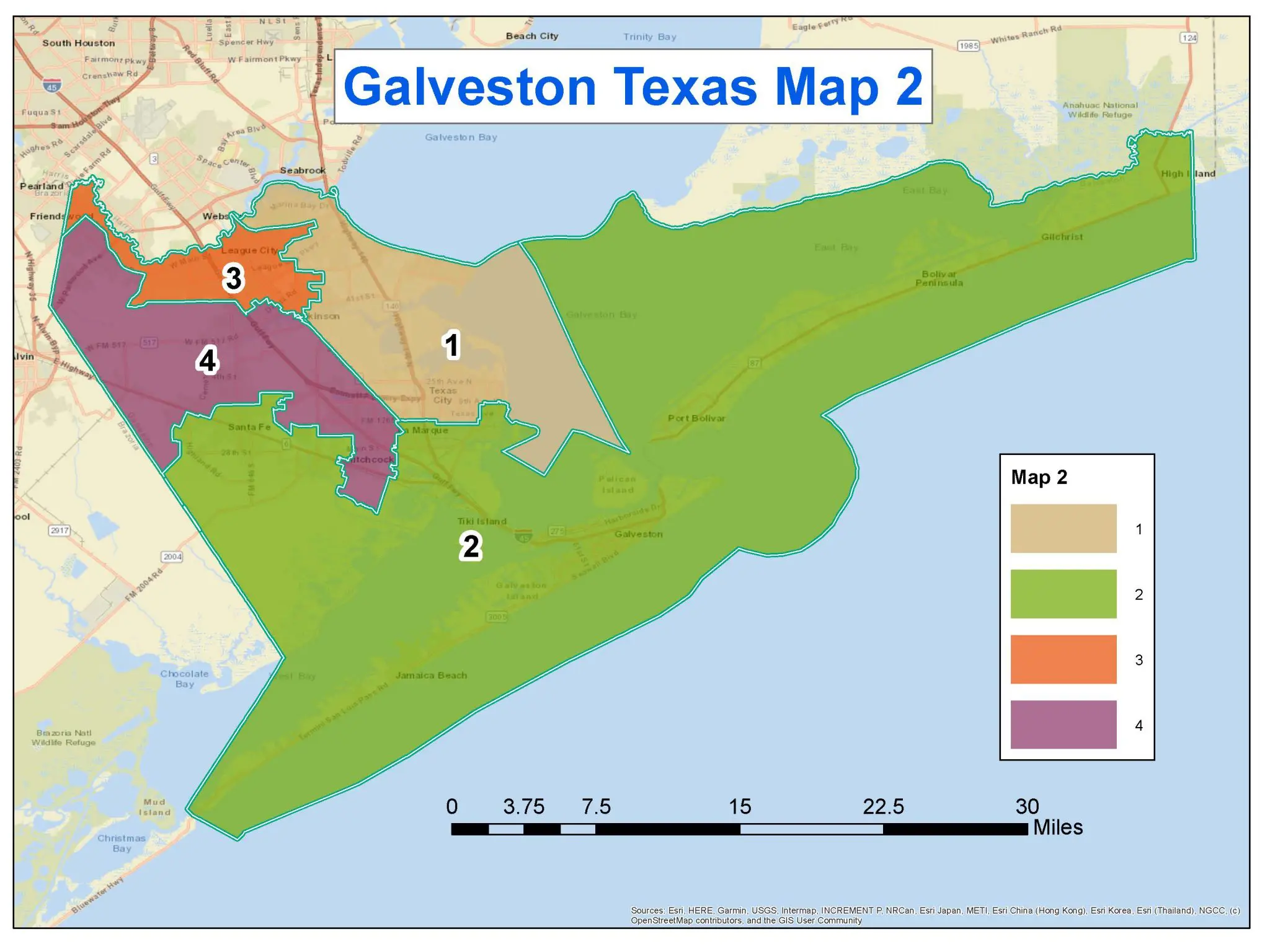
The dispute stems from a June decision by the Galveston County Commissioners Court to redraw boundaries for county commissioner, justice of the peace and constable precincts. The vote came after the county had already conducted its March primary elections under a different map.
The new boundaries drew opposition from residents and Precinct 3 Constable Derreck Rose, who argued that switching maps after the primary violated state election law and constitutional protections. They sought emergency relief from the Texas Supreme Court after the 14th Court of Appeals declined to block the changes.
The ruling also comes amid a separate federal lawsuit challenging Galveston County’s redistricting on allegations of racial discrimination. The litigation centers on Precinct 3, which historically served as a majority-minority district representing significant Black and Hispanic populations.
The Texas Supreme Court’s decision does not resolve those underlying federal claims. Instead, Friday’s ruling focused on whether the county could change precinct boundaries after the election process had already begun.
Galveston County redraws precinct lines; eliminates majority-minority district (June 30, 2026)
A long-running legal battle over voting rights in Galveston County has entered a new phase after county commissioners approved new precinct maps that redraw the boundaries for constables and justices of the peace to align with the county’s controversial commissioners precincts.
The move comes as the county continues to defend its redistricting efforts in federal court, where plaintiffs argue the maps unlawfully dilute the voting strength of Black and Latino residents in violation of Section 2 of the Voting Rights Act of 1965.
The dispute stems from the county’s 2021 commissioners precinct map, which eliminated the county’s only majority-minority commissioners precinct. The case, Petteway v. Galveston County, centers on the county’s controversial 2021 redistricting plan, which completely dismantled Precinct 3. For decades, Precinct 3 stood as the county’s sole majority-minority district, allowing Black and Latino residents to successfully clear the path to elect their candidates of choice. A federal judge originally struck down the map in 2023, calling it a “mean-spirited” example of racial gerrymandering.
Even though Black and Latino residents combine to make up nearly 40% of the Galveston County population, people of color no longer made up the majority of a single precinct with the map approved in 2021, according to previous Houston Public Media reporting.
A federal district judge initially ruled the map violated the Voting Rights Act and ordered it redrawn, but the U.S. Court of Appeals for the Fifth Circuit later reversed that decision, holding that minority coalition districts are not protected under Section 2.
That ruling allowed the map to remain in effect and shifted control of the commissioners court, while the broader litigation continues.
Federal appeals court divided over Galveston County redistricting case
During Tuesday’s May 14, oral arguments, a full panel of federal appellate court judges found themselves divided over whether a coalition of voters of color should receive the same protections under the Voting Rights Act as a single group of protected citizens in a Galveston County redistricting case.
The 5th U.S. Circuit Court of Appeals wasn’t tasked with determining whether Galveston County commissioners discriminated against Black and Latino voters when dismantling a district primarily composed of voters of color. Instead, the judges considered whether a coalition of Black and Latino voters should be afforded equal protections under the 1965 Voting Rights Act.
While some judges cautioned that extending protections to groups of minority voters could lead to a surge of discrimination claims, others saw merit in including coalitions in the Voting Rights Act to prevent voter dilution.
Judge Dana Douglas emphasized the need to interpret the Voting Rights Act broadly to combat racial discrimination effectively.
The case originated from concerns that local officials violated the rights of Black and Latino voters during a precinct redrawing process. Nicolas Riley, representing the Justice Department, argued that Galveston County’s redistricting efforts harmed both Black and Latino voters, suggesting they should be treated as a single “class” under the Voting Rights Act.
However, Judge Edith Brown Clement expressed skepticism, suggesting that the Supreme Court would have addressed coalition voters in previous rulings if they were a valid concept.
Joseph Nixon, representing Galveston County, contended that the Voting Rights Act only bars discrimination against a single group of voters. He warned against allowing coalition claims, arguing that it could lead to political manipulation.
The judges grappled with the complexities of racial identification, particularly for mixed-race individuals, highlighting the challenges of categorizing voters into singular groups.
The case underscores the ongoing debate over the interpretation of the Voting Rights Act and its application to diverse voter coalitions. The 5th Circuit has yet to announce a ruling on the matter.
Source: Houston Public Media / The Texas Tribune