

Black Politics Now
  • Home
  • Business
  • Civil Rights
  • Criminal Justice
  • Education
  • Elections
  • Health
  • Policy
  • Reparations
  • Voting Rights
No Result
View All Result
  • Login
  • Register
Black Politics Now
  • Home
  • Business
  • Civil Rights
  • Criminal Justice
  • Education
  • Elections
  • Health
  • Policy
  • Reparations
  • Voting Rights
No Result
View All Result
Black Politics Now
No Result
View All Result

Supreme Court unanimously rejects ‘moment of threat’ doctrine, advancing police accountability

Black Politics Now by Black Politics Now
May 17, 2025
in Supreme Court
0
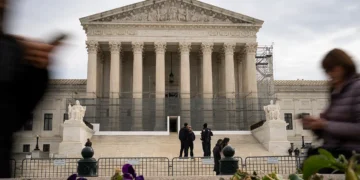
The U.S. Supreme Court building in Washington, captured on Nov. 2, 2024. (AP Photo/J. Scott Applewhite, File)

The U.S. Supreme Court building in Washington, captured on Nov. 2, 2024. (Photo courtesy of: AP Photo/J. Scott Applewhite, File)

74
SHARES
1.2k
VIEWS
Share on FacebookShare on Twitter

May 16, 2025 Story by: Publisher

You might also like

Supreme Court strikes down Louisiana’s second majority-Black district, weakens Voting Rights Act legal standard

Supreme Court upholds Texas’ congressional map for 2026 midterm election

Supreme Court declines to block California’s new congressional map

This article was updated to include additional background information and a statement from the Legal Defense Fund.

The Supreme Court unanimously overturned the dismissal of a civil‑rights lawsuit by Ashtian Barnes’s family on May 15, 2025, rejecting the narrow “moment‑of‑threat” doctrine and sending the case back for further review.

Writing for the Court, Justice Elena Kagan held that excessive‐force claims under the Fourth Amendment must be judged by the totality of the circumstances—including the events leading up to the use of deadly force—rather than focusing solely on the instant an officer perceives danger. The case, Barnes v. Felix ( No. 23-1239), now returns to the Fifth Circuit for further proceedings.

“Every year, Black people are killed by law enforcement officers and face immense hurdles to obtain justice. The moment of threat doctrine created another insurmountable barrier, rendering certain courts unable to assess whether an officer’s actions contributed to the violence or abuse that a person endured,” said Kevin E. Jason, Deputy Director of Strategic Initiatives at the Legal Defense Fund. “There can be no justice when courts are forced to ignore the actions of an officer that may have had a role in harming or killing a person. Today’s decision dismantles a dangerous legal framework and is an important step towards advancing police accountability.”

Background of the Shooting

On April 4, 2016, Deputy Constable Roberto Felix Jr. of Harris County confronted 24‑year‑old Ashtian Barnes during a traffic stop on the Sam Houston Tollway related to unpaid tolls. Barnes, driving a rental car unaware of the toll violations, began to drive off. Felix, having clung to the vehicle, fired two shots, striking Barnes in the torso. Barnes died at the scene.

Barnes’s mother, Janice Hughes Barnes, filed suit under 42 U.S.C. § 1983, alleging that Felix’s use of deadly force violated her son’s Fourth Amendment rights. The district court granted summary judgment to Felix, and the Fifth Circuit affirmed, applying its “moment‑of‑threat” test—which considers only the split‑second when an officer perceives danger—to dismiss the case.

In May 2025, the Legal Defense Fund (LDF) and the National Urban League, represented by O’Melveny & Myers LLP, filed an amicus brief in Barnes v. Felix, urging the Supreme Court to strike down the moment of threat doctrine, a dangerous legal framework that has undermined police accountability, encouraged police violence, and disproportionately harmed Black people.

The brief further argues that only looking to the “moment of threat” when evaluating police use of force risks irreparable damage to the protections of the Fourth Amendment, which has long required courts to assess the complete account of a police encounter with civilians, including officer misperceptions of threat arising out of racial stereotypes.  

Supreme Court’s Decision

  • Opinion: Justice Kagan, for a unanimous Court, rejected the “moment‑of‑threat” doctrine in favor of the long‐standing Graham v. Connor totality test, which assesses whether force is “objectively reasonable” under all circumstances.
  • Holding: Courts must consider factors such as the duration of the encounter, the officer’s conduct leading up to the force, departmental training on prone restraints, and whether lesser measures were available.
  • Result: The Supreme Court vacated the Fifth Circuit’s judgment and remanded for further proceedings, instructing lower courts to fully evaluate the context of Barnes’s traffic‐stop killing.

Legal Context and Implications

Totality of the Circumstances vs. Moment‑of‑Threat

Since Graham v. Connor (1989), courts have used a fact‐sensitive inquiry into whether an officer’s force was reasonable. The Fifth Circuit’s narrower approach, endorsed in Plumhoff v. Rickard (2014) for short pursuits, proved too restrictive for Barnes’s case. By reaffirming Graham, the Supreme Court ensures that excessive‐force claims account for the full sequence of events, not just a fleeting moment.

Qualified Immunity

Although reviving the suit, the Court did not eliminate qualified immunity. Felix may still argue that his rights were not “clearly established” under Fourth Amendment precedent. Nonetheless, plaintiffs now have a clearer path past summary judgment in cases where evidence shows questionable escalation by officers.

Broader Impact

Civil‐rights advocates hailed the ruling as a victory for police accountability, particularly in non‑arrest encounters and mental‐health crises. “This decision corrects a dangerous misapplication of the Fourth Amendment,” said a Brooklyn Law School expert. Law enforcement groups caution it could lead to more litigation over split‑second decisions, though the Court emphasized deference to officer judgment when reasonableness is genuinely debatable.

Next Steps

On remand, the Fifth Circuit must reassess Barnes’s claims under the totality framework. If Barnes’s family survives this round, their suit could proceed to trial, potentially influencing future excessive‑force litigation nationwide. A final resolution may hinge on the evolution of qualified immunity doctrine and departmental policy reforms.

Sources: Reuters / Houston Chronicle / AP News / Legal Defense Fund
Tags: “moment‑of‑threatBarnes v. FelixCivil rights advocatesFourth AmendmentGraham v. Connorlaw enforcement officersphysical injuriesSection 1983 of the Civil Rights ActU.S. Supreme Court
Share30Tweet19
Black Politics Now

Black Politics Now

Recommended For You

Supreme Court strikes down Louisiana’s second majority-Black district, weakens Voting Rights Act legal standard

by Black Politics Now
May 17, 2026
0
The U.S. Supreme Court building in Washington, captured on Nov. 2, 2024. (AP Photo/J. Scott Applewhite, File)

The court rules that the 2024 map, which created a second majority-black district, was "an unconstitutional racial gerrymander."

Read moreDetails

Supreme Court upholds Texas’ congressional map for 2026 midterm election

by Black Politics Now
May 14, 2026
0
Trump petitions Supreme Court to stop reinstatement of fired NLRB and MSPB members; court permits firings to continue for now

The U.S. Supreme Court has upheld Texas’ newly redrawn congressional map, allowing it to remain in place for the 2026 midterm elections.

Read moreDetails

Supreme Court declines to block California’s new congressional map

by Black Politics Now
April 29, 2026
0
Contemplating representation: Black voters in fresh congressional district reflect on its true significance

The move preserves the map approved by California voters under Proposition 50, enabling the state to use the new districts in the November elections.

Read moreDetails

Supreme Court blocks redrawing of New York congressional map

by Black Politics Now
May 2, 2026
0
Supreme Court wrestles with Louisiana congressional map’s future

A New York state judge had ruled earlier this year that the district, as currently drawn, violated the state constitution because it diluted the voting power of Black...

Read moreDetails

Justices Jackson and Thomas clash over judicial power and ideological shifts

by Black Politics Now
April 18, 2026
0
The U.S. Supreme Court building in Washington, captured on Nov. 2, 2024. (AP Photo/J. Scott Applewhite, File)

The remarks, delivered in separate venues, highlight a deepening divide within the Supreme Court over the use of emergency powers and the broader direction of American legal culture.

Read moreDetails
Next Post
2020 Census Data and 2021 Redistricting Maps. Credit: Michael Gonzalez/The Texas Tribune

Tarrant County’s mid‑decade redistricting sparks fears of a diluted Black vote

Leave a Reply Cancel reply

Your email address will not be published. Required fields are marked *

ADVERTISEMENT

Related News

A young girl proudly holds a "Black Voters for Harris-Walz" sign outside the election night watch party for Democratic presidential nominee Vice President Kamala Harris at Howard University in Washington on Tuesday, Nov. 5. (AP photo/Terrance Williams)

Here’s What Exit Polls Say About Black Voters Support For Kamala Harris

November 9, 2024
Tulsa Mayor-elect Monroe Nichols in his transition office located at Tulsa City Hall. Dylan Goforth / The Frontier

Mayor Nichols to unveil ‘Road to Repair’ for survivors and descendants of 1921 Tulsa Race Massacre

April 7, 2025
Businessman and state legislator Jacob N. Donohoo founded the Southwestern Investment, Trust, and Banking Association in Pine Bluff in 1902. (Image courtesy of the Butler Center for Arkansas Studies, Central Arkansas Library System)

Arkansas had nearly 100 Black legislators between between 1868-1893

February 11, 2025
Black Politics Now

Get informed on African American politics with "Black Politics Now," your ultimate source for political engagement.

CATEGORIES

  • Business
  • Civil Rights
  • Congressional Black Caucus
  • Criminal Justice
  • Data
  • Department of Justice
  • Diversity Initiatives
  • Education
  • Elections
  • Enviroment
  • Equity
  • Hate Crimes
  • Health
  • Housing
  • Investigations
  • Legal Defense Fund
  • NAACP
  • Policy
  • Real Estate
  • Reparations
  • Research
  • Sports
  • State Issues
  • Study
  • Supreme Court
  • Technology
  • Voting Rights
  • World

Quick Link

  • Privacy Policy
  • Terms of service
  • Contact us

Download Our App

© 2024 Black Politics Now | All Right Reserved

Welcome Back!

Login to your account below

Forgotten Password? Sign Up

Create New Account!

Fill the forms bellow to register

All fields are required. Log In

Retrieve your password

Please enter your username or email address to reset your password.

Log In
wpChatIcon
wpChatIcon
No Result
View All Result
  • Home
  • Business
  • Civil Rights
  • Criminal Justice
  • Education
  • Elections
  • Health
  • Policy
  • Reparations
  • Voting Rights
  • Login
  • Sign Up
  • Cart
SUBSCRIBE

© 2024 Black Politics Now | All Right Reserved

Join the Movement, Subscribe Now!(Don't worry, we'll never spam you!)

Don’t miss a beat—get the latest news, inspiring stories, and in-depth coverage of the issues that matter most to the Black community. Be part of the conversation and stay connected.

Enter your email address